The eight-year-old daughter that I don't have rushes into my office, leaps onto my lap, and asks me to help her with her homework. We spend a few minutes doing basic math and practicing her spelling. She's got her d's and b's switched around. She's bright and precocious and she's missing an upper tooth. She's got curly brown hair, like me, and when she zips out of the room she turns her head and her corkscrew curls bounce wildly and she says, "Thank you, Daddy." My dog, Edgar, who is real, runs after her.
I look down at my computer monitor and there's a line about a man who is fighting his friend, trying to stop him from killing someone. I fiddle with the line. I add to it. It becomes two sentences, then a paragraph. Then a page.
I head downstairs. My father, who's been dead for 35 years, is standing on my patio with a spatula in hand, occasionally flipping burgers on the grill. He looks the same as he did when he died at 46. I'm nearly as old as he is now. I have more gray in my hair than he does. I sit at the picnic table and start reading the paper and we talk about...something. I don't know what. I can't really hear him. I don't remember the sound of his voice. I remember his smile though. He's smiling now.
My mother, whose been gone 7 years, is in the kitchen making salad. She calls out to my father and asks him what kind of dressing he'd like. He doesn't respond because he's feeding Edgar one of the hotdogs he's overcooked. My daughter is beside me. She's laughing and her laughter fires through my chest and fills me so much joy that I feel like my heart will explode.
I look down at my computer monitor and there's a line about a woman turning over in bed and asking someone to kill her husband.
Edgar lies down at my feet and nestles his chin on top of my foot. I glance out the window at the back yard. The grill is cold. The patio furniture has been put away in the shed.
My daughter stands in the doorway crying. She bumped her knee. I hold her, shushing her, until she quiets. She goes to sleep in my arms. I press my nose to her hair and breathe in her scent deeply.
I'm chewing on a pen. My hands are a blur on the keypad. The next page is about a Hollywood agent trying to rip off a client.
This is how my workday goes.
Writers slip in and out of identities. We can be cops or gunmen or high-paid assassins. We can be heroes or badasses. That's where the work takes us, into our own fantasies, into romanticized notions of ourselves.
And then drops us back into our real selves. And at least one element of that fantasy is comprised of daydreams–the common and average daydreams that fill out my common and average life. The people I miss are returned to me. The ones who were never born are there for me to cuddle and protect. It's what happens when my mind wanders. I drift. I dive into the page. I call back to memory. I get swept away. Sometimes it goes so far that when I'm snapped back into myself it's something of a shock and I feel like someone's thrown cold water in my face. I suck air through my teeth like I've been holding my breath for minutes. Maybe I have. That's the power, the pain, the gift and the disappointment of trying on someone else's skin. Even if that someone else looks exactly like me.
My daughter asks if I'm busy. I tell her no. She giggles and asks me to read her a story.
My hands flash. I shut my eyes and the writing continues.
About Me

- Tom Piccirilli
- "We need to make books cool again. If you go home with someone & they don't have books, don't fuck 'em."--John Waters
I'm the author of more than twenty novels including SHADOW SEASON, THE COLD SPOT, THE COLDEST MILE, THE MIDNIGHT ROAD, THE DEAD LETTERS, and A CHOIR OF ILL CHILDREN. Look for my next one THE LAST KIND WORDS due out May '12 from Bantam Books. Contact: PicSelf1@aol.com
Monday, March 9, 2009


Thursday, March 5, 2009
Neo-Noir, Baby
The Cold books are heavily influenced by the 50s Gold Medal classic authors such as David Goodis, Charles Williams, Jim Thompson, Harry Whittington, Peter Rabe, Bruno Fischer, Gil Brewer, and Donald Westlake (Richard Stark). For those of you who don't know, Gold Medal was a paperback publisher noted especially for its crime fiction. Unless you live and breathe this kind of writing (and even if you don't, you should keep your eyes open when hanging around the secondhand shops), you've probably only heard of one or two of those names in passing.
But they were all something special back in the day–many of them massive bestsellers--and even if they're mostly forgotten now, they remain special in their own right. You've seen a lot of movies based on their books, even if you didn't know it. Their influence is felt throughout the entire mystery genre. And there's been a recent resurgence in this specific kind of noir/hardboiled material. Current authors like Charlie Huston, Duane Swierczynski, Sean Doolittle, and Ken Bruen (check The Big Adios for interviews with all these guys) have run with noirish tropes and taken them to new heights...or, more accurately put, new depths.
When I started work on THE COLD SPOT and THE COLDEST MILE I went in with the hopes of distilling just about everything I loved about the form, the themes, the action, and the humor, and pouring all of that into my own work. Creating my protagonist, Chase, who lived in the underworld of crime but still had his own code of honor, and finding out what might push his buttons. What might bring out the best in him, and the worst. And what might force him to consider breaking that code and becoming the person that he most hated in the world...his own grandfather, Jonah.
If it's one thing those classic writers knew about, it was how to keep a story moving at full-speed. I also wanted to stomp the pedal and let the engine scream. I wanted to write hardboiled but with some real heart and soul. Moments of grace and reflection. I thought it was important to have more thoughtful elements in the books to help balance the story out. It's a part of who I am and what my worldview is. Action is terrific but you need a greater context. The work has to actually be ABOUT something. I've got things I want to examine and scrutinize. Things that genuinely matter to me. The hardboiled and noir elements are there to underscore and dramatize all the other stuff. The Cold books are as much about family, loss, love, and heartache as they are about guns and scores and wheelmen. And sometimes the bloody action scenes and the emotionally-charged ones are the same.
That's one of the things I like best about the crime genre. You never know when someone is going to shake hands or pull a S&W .38. Or betray a friend or save a life. Or fall in love or dive into lifelong hatred. The whole human condition from best to worst can crop up at any second.
But they were all something special back in the day–many of them massive bestsellers--and even if they're mostly forgotten now, they remain special in their own right. You've seen a lot of movies based on their books, even if you didn't know it. Their influence is felt throughout the entire mystery genre. And there's been a recent resurgence in this specific kind of noir/hardboiled material. Current authors like Charlie Huston, Duane Swierczynski, Sean Doolittle, and Ken Bruen (check The Big Adios for interviews with all these guys) have run with noirish tropes and taken them to new heights...or, more accurately put, new depths.
When I started work on THE COLD SPOT and THE COLDEST MILE I went in with the hopes of distilling just about everything I loved about the form, the themes, the action, and the humor, and pouring all of that into my own work. Creating my protagonist, Chase, who lived in the underworld of crime but still had his own code of honor, and finding out what might push his buttons. What might bring out the best in him, and the worst. And what might force him to consider breaking that code and becoming the person that he most hated in the world...his own grandfather, Jonah.
If it's one thing those classic writers knew about, it was how to keep a story moving at full-speed. I also wanted to stomp the pedal and let the engine scream. I wanted to write hardboiled but with some real heart and soul. Moments of grace and reflection. I thought it was important to have more thoughtful elements in the books to help balance the story out. It's a part of who I am and what my worldview is. Action is terrific but you need a greater context. The work has to actually be ABOUT something. I've got things I want to examine and scrutinize. Things that genuinely matter to me. The hardboiled and noir elements are there to underscore and dramatize all the other stuff. The Cold books are as much about family, loss, love, and heartache as they are about guns and scores and wheelmen. And sometimes the bloody action scenes and the emotionally-charged ones are the same.
That's one of the things I like best about the crime genre. You never know when someone is going to shake hands or pull a S&W .38. Or betray a friend or save a life. Or fall in love or dive into lifelong hatred. The whole human condition from best to worst can crop up at any second.
Saturday, February 28, 2009
Fuck Outlining
For all you folks on Facebook who've got me friended, you might want to check my latest UPDATE STATUS and the gentleman's discussion that's arisen from it. I'm not sure if that link will work, but if not, just head over to my page anyhow and read up on the discussion about whether to outline a novel or not. Somehow noted authors Ray Garton and John Passarella have been roped into it, with some further comments by the one and only Trey R. Barker too.
I hate outlining (in case you didn't get that from the FUCK OUTLINING title of this post). I find the process of writing to be more organic. I need to dive in and find the story as I actually make my way through the material. I've never quite understood folks who outline beforehand--whether it's a two page or ten page or, as in one case I recall when I was a first reader at an SF publishing house, a 180 page outline. I don't fully understand how you can know what the story is about before you actually write it. How do you know what your characters will do when you don't really know who the characters are? Where does the emotional context come in? Where is your personal surprise and discovery?
What do the rest of you kids think?
I hate outlining (in case you didn't get that from the FUCK OUTLINING title of this post). I find the process of writing to be more organic. I need to dive in and find the story as I actually make my way through the material. I've never quite understood folks who outline beforehand--whether it's a two page or ten page or, as in one case I recall when I was a first reader at an SF publishing house, a 180 page outline. I don't fully understand how you can know what the story is about before you actually write it. How do you know what your characters will do when you don't really know who the characters are? Where does the emotional context come in? Where is your personal surprise and discovery?
What do the rest of you kids think?
Tuesday, February 24, 2009
Fast Cars, Dark Bars, Me & Noir
My latest novel THE COLDEST MILE, follow-up to my Edgar Award-nominated THE COLD SPOT, officially streets today. Amazon.com has been shipping for the past week or so. Most stores should have it in stock, but if not, you can always special order it.
I hope that everyone who gives it a go really enjoys it. Feel free to drop me a line and send me a link if you blog about it (good or bad) or do a review on Amazon.com or B&N.com. Nowadays, novels live or die by word of mouth as much as by anything else.
Some blurbs:
"[Tom Piccirilli’s] prose has the visceral punch of the best pulp writers of the past century…."—Eddie Muller, San Francisco Chronicle
"Hard-boiled crime writing ... It’s pedal to the metal for 352 pages. Don’t miss it."—Booklist
"Prepare for a journey as thrilling as it is provocative." —James Rollins, author of The Judas Strain
"Blackest noir, the most minimal kind of minimalism, and at the same time deeply emotional: this is not easy to do."—Peter Abrahams, bestselling author of Nerve Damage
"The book roars off the line with all the force and forward velocity of two tons of Detroit muscle car and never lets up on the pace. Crime novels don't get faster or grittier than this one, and in Chase, Tom has created a character who'll stick with you for years to come."–Mysterious Galaxy Bookstore
Several folks have asked merecently about what kind of process I use when writing. Whether I outline in detail or just dive in and sink or swim on my own.
For me, the process is very organic. It needs to be a journey of surprise and discovery, otherwise I don’t really see the point of writing at all. I’m here to discover something about myself, my values, what I do think, what I do mean, what I do understand of life. The only way for that to happen is to start the story and then see what new places it leads me. Once I’m on some different ground, I have a different perspective. If my perspective wasn’t always shifting, I’d just be telling the same story over and over.
I’m not sure where the need to write comes from except to say that the need to fantasize has always been with me. We all need a mixture of the world as it is and the world as metaphor, as art. A fundamental part of the human condition is to take what we know of reality and reshape it, rethink it, reimagine it. And then reapply it somehow to our own lives. When the process stalls, I get it going again by any means necessary. I have to. I pray to the great god mortgage and the only way I can pay my bills is off what I produce. The responsibilities of my life can only be attended to through my art. I can only take care of my family through my work.
Some people think that writing for money is selling out. But I’m here to tell you, kids, it’s the opposite. It means walking the wire without a net. You gamble your fate on the possibility that you can grind out another book or story no matter what. It means you have to go out and track your inspiration down and wrestle it to the floor every single day. That’s not selling out your work. That’s putting the greatest amount of faith in it. The roof over your head is at stake. The food in your mouth is at stake. Your very life is at stake.
I hope that everyone who gives it a go really enjoys it. Feel free to drop me a line and send me a link if you blog about it (good or bad) or do a review on Amazon.com or B&N.com. Nowadays, novels live or die by word of mouth as much as by anything else.
Some blurbs:
"[Tom Piccirilli’s] prose has the visceral punch of the best pulp writers of the past century…."—Eddie Muller, San Francisco Chronicle
"Hard-boiled crime writing ... It’s pedal to the metal for 352 pages. Don’t miss it."—Booklist
"Prepare for a journey as thrilling as it is provocative." —James Rollins, author of The Judas Strain
"Blackest noir, the most minimal kind of minimalism, and at the same time deeply emotional: this is not easy to do."—Peter Abrahams, bestselling author of Nerve Damage
"The book roars off the line with all the force and forward velocity of two tons of Detroit muscle car and never lets up on the pace. Crime novels don't get faster or grittier than this one, and in Chase, Tom has created a character who'll stick with you for years to come."–Mysterious Galaxy Bookstore
Several folks have asked merecently about what kind of process I use when writing. Whether I outline in detail or just dive in and sink or swim on my own.
For me, the process is very organic. It needs to be a journey of surprise and discovery, otherwise I don’t really see the point of writing at all. I’m here to discover something about myself, my values, what I do think, what I do mean, what I do understand of life. The only way for that to happen is to start the story and then see what new places it leads me. Once I’m on some different ground, I have a different perspective. If my perspective wasn’t always shifting, I’d just be telling the same story over and over.
I’m not sure where the need to write comes from except to say that the need to fantasize has always been with me. We all need a mixture of the world as it is and the world as metaphor, as art. A fundamental part of the human condition is to take what we know of reality and reshape it, rethink it, reimagine it. And then reapply it somehow to our own lives. When the process stalls, I get it going again by any means necessary. I have to. I pray to the great god mortgage and the only way I can pay my bills is off what I produce. The responsibilities of my life can only be attended to through my art. I can only take care of my family through my work.
Some people think that writing for money is selling out. But I’m here to tell you, kids, it’s the opposite. It means walking the wire without a net. You gamble your fate on the possibility that you can grind out another book or story no matter what. It means you have to go out and track your inspiration down and wrestle it to the floor every single day. That’s not selling out your work. That’s putting the greatest amount of faith in it. The roof over your head is at stake. The food in your mouth is at stake. Your very life is at stake.
Tuesday, February 10, 2009
In the Middle of My Funk

A couple of nice things happened this morning while I was in the middle of a particularly cruel funk (and no, nothing really happened, I was just feeling funky). I received the first copy of THE COLDEST MILE hot off the presses. And yes, I realize how ironic it is to use "coldest" and "hot" in the same sentence, but hey, that's what writers get paid for. To use artistic license like that to make a point and call attention to ourselves.
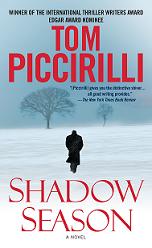
Also got a mock-up of the cover for my next novel SHADOW SEASON, due out in October. It'll be tweaked some and have blurbs added, but as is I think it's wonderfully rendered and encompasses the same kind of atmosphere that the novel itself does. There's a bleakness to it but also a real moody beauty to it. You know you've got a good cover when you worry if the book will do the art fucking justice.
Okay, so--
Facebook has been sort of derailing me lately. I've been on there six or eight months, something like that, but it seems like everyone from my past has suddenly joined the site in the past few weeks. Old buddies, school chums, ex-girlfriends, you name it. I've got a natural inclination toward nostalgia, good and bad, and lately I can't quite keep as focused as I like to be because I'm dwelling on the past. I mean dwelling on the past even MORE than I usually do. A ton of memories have come surging in and, being the hyper-sensitive weenie that I am, I've been getting a little kicked around by it all. I've been lost in playing Let's Remember and thinking about the laughs, the heartaches, first loves, first lays, big fallouts over nothing, the wasted time, the damned and the dead, the initial call to be a writer.
So all you other funky people, does this shit happen to you? You ever hit a patch where you just can't pull yourself from the draw of the past? When your head is filled with the faces of people you haven't seen in ten or twenty or more years? Some of whom you can still reach out to and some who are long buried? What funky stuff have you been into lately?
Saturday, February 7, 2009
New Interview up at THE BIG ADIOS
For anyone interested, you can read a new interview with me over at THE BIG ADIOS conducted by founder/owner David T. Wilbanks. It focuses mostly on THE COLDEST MILE and the state of current affairs in the publishing biz. Hope you'll all check it out. And while you're there take time to peruse the forum a bit. It's a great place to learn about crime fiction and film from the noir/hardboiled classics to what's on the horizon.
Monday, February 2, 2009
Booklist review of THE COLDEST MILE
The first review of THE COLDEST MILE is in, and it's a rave from Booklist (due out in the Feb. 15th issue, but here's a sneak peek). As a fan of classic noir Gold Medal noir fiction, the comparison to my personal literary heroes Jim Thompson and David Goodis is especially gratifying.
"Piccirilli’s latest book strips away the occult overtones associated with some of his earlier works (The Night Class won the 2002 Stoker Award) and jumps full bore into hard-boiled crime writing. This guy evokes Jim Thompson and David Goodis in the way he flays away at our illusions that there is comfort to be found in the human condition. Cranked by stolen cars and raw nerve, getaway driver Chase takes a violent cruise through the world of gangsters high and low, hoping to settle old scores with his con-man grandfather and avenge the murder of his wife. But first he needs some capital, which means a quick score. What Piccirilli’s masterfully realized protagonist gambles is his last remaining glimmer of dignity—a commodity he isn’t sure he needs or even wants. It’s pedal to the metal for 352 pages. Don’t miss it." — Elliott Swanson, Booklist
"Piccirilli’s latest book strips away the occult overtones associated with some of his earlier works (The Night Class won the 2002 Stoker Award) and jumps full bore into hard-boiled crime writing. This guy evokes Jim Thompson and David Goodis in the way he flays away at our illusions that there is comfort to be found in the human condition. Cranked by stolen cars and raw nerve, getaway driver Chase takes a violent cruise through the world of gangsters high and low, hoping to settle old scores with his con-man grandfather and avenge the murder of his wife. But first he needs some capital, which means a quick score. What Piccirilli’s masterfully realized protagonist gambles is his last remaining glimmer of dignity—a commodity he isn’t sure he needs or even wants. It’s pedal to the metal for 352 pages. Don’t miss it." — Elliott Swanson, Booklist
Subscribe to:
Posts (Atom)